
Nov
6
Musical Flower Clock
Lithuanian National Philharmonic Society, Aušros Vartu str. 5, Vilnius, Lithuania
Wednesday, 19:00
Event is over: 2024-11-06
Event is expired

Contact us
Event information
Performers:
ZBIGNEVAS IBELHAUPTAS (piano)
RŪTA RIKTERĖ (piano)
ROBERTAS BEINARIS (oboe)
MUSICA HUMANA Ensemble
(artistic director and conductor Robertas Beinaris)
Programme:
ANTONIO VIVALDI – Trio sonata in D minor, No. 12, Op. 1, La Folia, RV 63 (arrangement by Gediminas Kviklys)
WILHELM FRIEDEMANN BACH – Sonata for two pianos in F major, F. 10
JOHANN SEBASTIAN BACH – Concerto for two pianos and orchestra in C major, BWV 1061
JEAN FRANÇAIX – L’horloge de flore (The Flower Clock, arrangement by Robertas Beinaris and Gediminas Kviklys)
DARIUS MILHAUD – Suite Scaramouche, Op. 165b (arrangement by Arūnas Navakas)
The idea of a flower clock, marking the time of day with flowers blooming at different hours of the day, inspired the Musical Flower Clock. The unexpected parallels are embodied in works representing different eras of music history. The lines of the musical flower clock’s dial are defined by a dialogue between Neoclassicism and Baroque, brought together through various musical and thematic links.
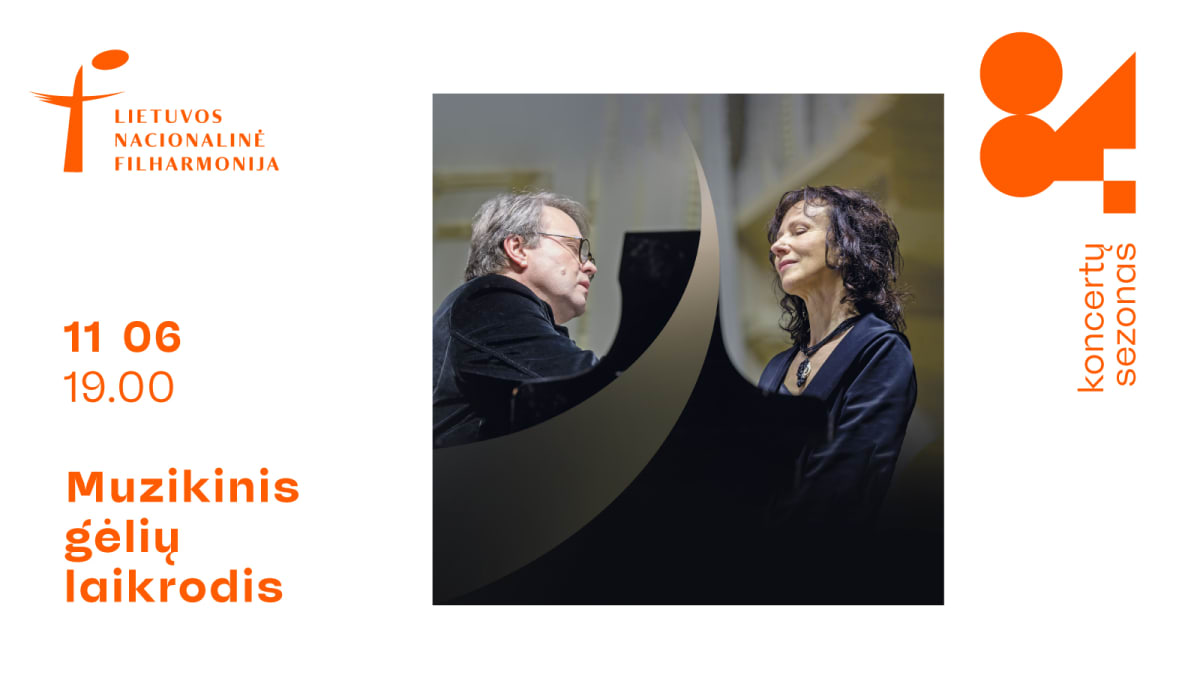
Musica Humana Ensemble and its guests, Z. Ibelhauptas and R. Rikterė Piano Duo, will transfer the audience to different historical periods.
Françaix’s L’horloge de flore (1959) takes us back to the heyday of Charles de Gaulle and French New Wave. Each part of L’horloge de flore is a small musical mise-en-scene depicting a different time of day and the flower that blooms during it.
Counting of the musical hours will begin with Frenchman Milhaud’s sonic interpretation of Molière’s plays. The allusion to those times is not just the composer’s extramusical fantasy – the suite Scaramouche (1937) is full of stylisations of the music of the playwright’s contemporary, Johann Sebastian Bach, while the element of comedy inherent in Molière is conveyed by the elements characteristic of interwar French music.
The journey from the 20th century to the Baroque is smooth and easy – through the Sonata for two pianos by W.F. Bach, an early classicist composer and one of Bach’s sons, stopping at the last work of Vivaldi’s first cycle of sonatas, and ending with the quintessence of the Baroque itself – Piano concerto for two pianos by J.S. Bach.
ZBIGNEVAS IBELHAUPTAS (piano)
RŪTA RIKTERĖ (piano)
ROBERTAS BEINARIS (oboe)
MUSICA HUMANA Ensemble
(artistic director and conductor Robertas Beinaris)
Programme:
ANTONIO VIVALDI – Trio sonata in D minor, No. 12, Op. 1, La Folia, RV 63 (arrangement by Gediminas Kviklys)
WILHELM FRIEDEMANN BACH – Sonata for two pianos in F major, F. 10
JOHANN SEBASTIAN BACH – Concerto for two pianos and orchestra in C major, BWV 1061
JEAN FRANÇAIX – L’horloge de flore (The Flower Clock, arrangement by Robertas Beinaris and Gediminas Kviklys)
DARIUS MILHAUD – Suite Scaramouche, Op. 165b (arrangement by Arūnas Navakas)
The idea of a flower clock, marking the time of day with flowers blooming at different hours of the day, inspired the Musical Flower Clock. The unexpected parallels are embodied in works representing different eras of music history. The lines of the musical flower clock’s dial are defined by a dialogue between Neoclassicism and Baroque, brought together through various musical and thematic links.
Musica Humana Ensemble and its guests, Z. Ibelhauptas and R. Rikterė Piano Duo, will transfer the audience to different historical periods.
Françaix’s L’horloge de flore (1959) takes us back to the heyday of Charles de Gaulle and French New Wave. Each part of L’horloge de flore is a small musical mise-en-scene depicting a different time of day and the flower that blooms during it.
Counting of the musical hours will begin with Frenchman Milhaud’s sonic interpretation of Molière’s plays. The allusion to those times is not just the composer’s extramusical fantasy – the suite Scaramouche (1937) is full of stylisations of the music of the playwright’s contemporary, Johann Sebastian Bach, while the element of comedy inherent in Molière is conveyed by the elements characteristic of interwar French music.
The journey from the 20th century to the Baroque is smooth and easy – through the Sonata for two pianos by W.F. Bach, an early classicist composer and one of Bach’s sons, stopping at the last work of Vivaldi’s first cycle of sonatas, and ending with the quintessence of the Baroque itself – Piano concerto for two pianos by J.S. Bach.
Important information
To purchase more than 10 tickets, contact info@kakava.lt
Door opens before: 18:00. Po trečio skambučio žiūrovai neįleidžiami
Duration: ~2 val.
Breaks: 20 min. Koncertas dviejų dalių
Children are admitted free of charge: no
Age of consent: 7 years
Discounts: LNPS discounts
Nuolaida taikoma tik bilieto kainai. Paslaugos mokesčiui nuolaida netaikoma.
Nuolaida taikoma tik bilieto kainai. Paslaugos mokesčiui nuolaida netaikoma.
Other: Due to the smaller spacing on the balcony of the Lithuanian National Philharmonic Concert Hall, we recommend that taller listeners or listeners with leg problems choose balcony row 1 or row 9 seats 9–11.
About event organizer
KĮ Lietuvos nacionalinė filharmonija, Juridinis asmuo
Aušros Vartų g. 5, 01304, Vilnius, Lietuva
Company number 300011619
VAT number LT100000876811
Email: bilietai@filharmonija.lt
Phone no.: +37061441725
Website: www.filharmonija.lt/
The Ticket seller (kakava.lt) operates as a disclosed agent. Responsibility for the event and its quality is borne by the event organiser. The organiser makes decision regarding the refunding arrangements in case of cancellation or postponement of the event.
