
 3 people are currently interested in the event
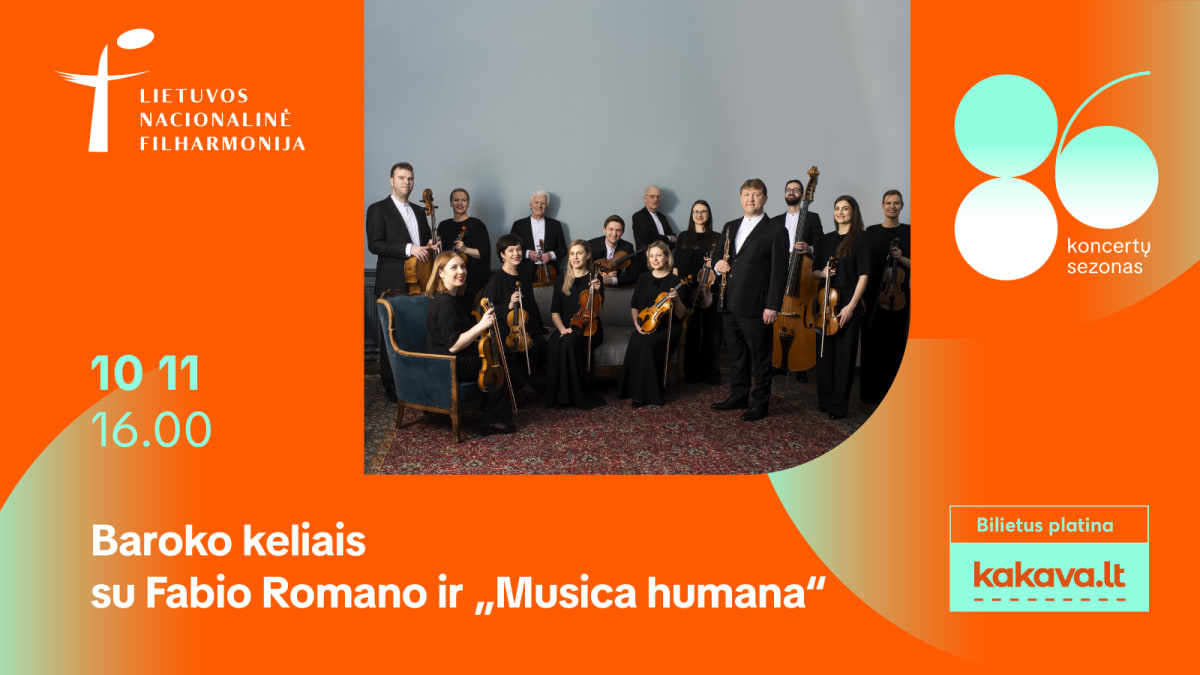
Baroque Pathways with Fabio Romano and Musica humana

Event information
MUSICA HUMANA Ensemble
Artistic director, soloist and conductor ROBERTAS BEINARIS (oboe)
Soloists:
FABIO ROMANO (piano, Italy)
TOMA BANDZAITYTĖ-PUPLAUSKĖ (violin)
ANDRIUS PUPLAUSKIS (bassoon)
Conductor and soloist ROBERTAS BEINARIS (oboe)
Programme:
ANTONIO VIVALDI – Concerto for two violins, strings and basso continuo in D major, RV 512 (arranged for violin, bassoon and strings by Toma Bandzaitytė-Puplauskė and Andrius Puplauskis)
JOHANN SEBASTIAN BACH – Concerto for harpsichord, two violins, viola, cello and basso continuo in D minor, BWV 1052
ANTONIO VIVALDI – Concerto for bassoon and orchestra in A minor, RV 498; Sinfonia to the opera L’Olimpiade, RV 725; Concerto for two oboes, strings and basso continuo in D minor, RV 535; Trio sonata for strings No. 12 in D minor, Op. 1, La Folia (arranged for string orchestra by Gediminas Kviklys)
Baroque masterpieces acquire a new sound in the original concert programmes of the Musica Humana Ensemble. This time, the Ensemble and its soloists will take the audience on a journey through the Baroque era from Germany to Italy. On this occasion, the Ensemble is joined by Fabio Romano, a pianist from Italy, who will be one of the concert’s soloists.
The Concerto in D minor for harpsichord, two violins, viola, cello and basso continuo by the German Baroque genius Johann Sebastian Bach is one of the composer’s most striking and virtuosic instrumental concertos. The work consists of three movements: a lively and dramatic first movement; a contrasting, tranquil second movement; and an energetic finale. Here, Bach’s ability to combine a rigorous polyphonic structure with expressive melodies is particularly evident.
From Germany the audience will travel to Venice, where another renowned master of Baroque instrumental music, Antonio Vivaldi, spent most of his life.
In the 18th century, Venice was known as a unique cultural hub: a politically independent republic and a city bustling with trade and tourism, where music was not only an art form but also an integral part of cultural identity. In this environment, the composer relied on highly theatrical modes of expression: not only opera but also the concerto and trio sonata genres.
This concert will feature both early and late works by Vivaldi, revealing the evolution of his style and the maturity of his artistry.
Important information
Discount applies to ticket price only. No discount on service charge.
About event organizer
KĮ Lietuvos nacionalinė filharmonija, Juridinis asmuo
The Ticket seller (kakava.lt) operates as a disclosed agent. Responsibility for the event and its quality is borne by the event organiser. The organiser makes decision regarding the refunding arrangements in case of cancellation or postponement of the event.
3 people are currently interested in the event