
 8 people are currently interested in the event
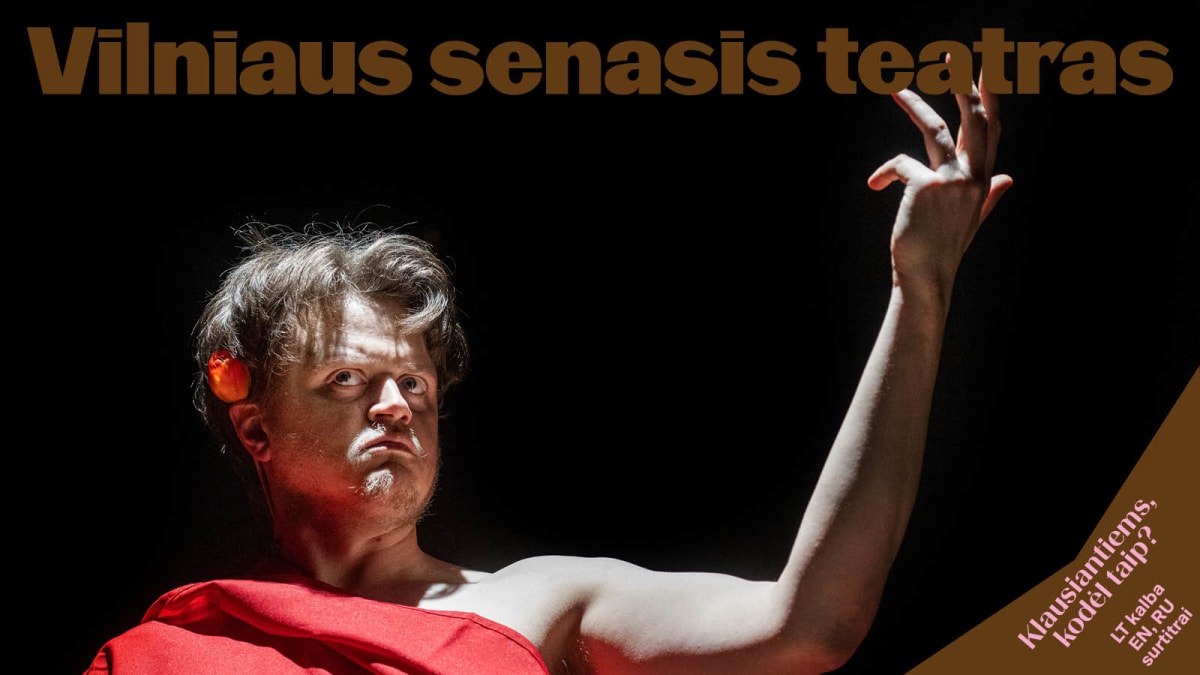
Albert Camus „KALIGULA“ (Rež. Jokūbas Brazys)
Naujasis Senojo teatro 113-asis sezonas: šokantis, performatyvus, dramatiškas
Spektaklis lietuvių kalba su angliškais ir rusiškais titrais.
Event information
Albert Camus
Caligula
Although Albert Camus’s play Caligula is based on historical events, it would be inaccurate to classify it simply as a traditional historical drama. Here, the author’s principal aim is to convey, in a distilled form, the core ideas of his philosophy and artistic world view: negation and affirmation, absurdity and rebellion, hope and faith.
Director Jokūbas Brazys’s interpretation of Caligula, however, is not confined to the image of a half-mad tyrant imprisoning the Roman Empire in his unbridled imagination. Instead, in this version played by Artur Svorobovič, Caligula’s story unfolds in a theatrical universe where anything can become a tool of tyranny: the repertory, the professional limits of fellow actors, and even the official (but non-native) language. In this interpretation, Caligula is less involved in burying his sister Drusilla than in attending the funeral of an already vanished theatre – one that blazes like a flame, still producing characters and stories from tears, blood, and sweat. In this sense, Caligula becomes a reflection on the changing face of theatre and on the actor, forever in search of his own ‘moon’.
Caligula himself can be seen as a character who embodies the anxieties and frustrations of the modern era, longing to purge and renew the world with fire. Here, he is a figure set on radical reinvention, cleansing the old order through bloodshed. Faced with pressing environmental crises and ruthless international conflicts, Caligula invites audiences to consider how individual and political resolve can influence global destiny. Caligula stands as a powerful symbol, reminding us that in the present world we must choose our path wisely. Will we opt for darkness and destruction, or can we still unearth a route to salvation?
Brazys notes: “The production is set in a theatre café – a vague, liminal space, a microcosm where reality and illusion overlap. Caligula’s actions serve as a kind of artistic provocation, laying bare the murkier corners of human nature and consciousness. He doesn’t simply pose questions but also becomes a symbol of humanity’s relationship to celestial bodies. Within the maze of freedom, Caligula is himself a hostage, celebrating martyrdom as deliverance and insisting that only through suffering can we discover genuine existence. From this emerges a formula where opposites – courage and fear – come crashing down like pillars onto human feet, pulverising them and giving way to Caligula’s emergence in this world. He is an explorer of theatre’s darker niches, where, beneath stage lights, blooms of mimosa appear as signposts to an inscrutable plot.”
///
Albert Camus (1913–1960) was a French writer and philosopher, awarded the Nobel Prize in Literature. He completed Caligula in 1938. While the play initially received a lukewarm response, the subsequent wartime publication of his novel The Stranger and the philosophical essay The Myth of Sisyphus in Nazi-occupied Paris encouraged a fresh perspective on Caligula. It then took on its full weight of meaning. This approach to storytelling became emblematic of Camus’s oeuvre: he would first present his philosophical ideas in essay form before converting them into novels and plays – works that, apart from their philosophical content, radiate undeniable artistic power.
Jokūbas Brazys (b. 1995), a student of directors Oskaras Koršunovas and Eimuntas Nekrošius, graduated in 2021 from the Lithuanian Academy of Music and Theatre with a degree in directing. His work includes productions based on Molière’s The Misanthrope, William Shakespeare’s Macbeth, Anton Chekhov’s The Seagull, Peter Shaffer’s Equus, and Ágota Kristóf’s The Notebook. Brazys collaborated with the Face Theatre Festival in Budapest, Volta On Line in Vilnius, and the 2019 Theatre Olympics in Saint Petersburg. He also worked as assistant director to Koršunovas on Rimantas Kmita’s Remyga at Šiauliai State Drama Theatre, and on Shakespeare’s Othello at OKT/Vilnius City Theatre.
Important information
30% discount for seniors and disabled 1 ticket
15% discount for 10 or more tickets
30% discount for Ukrainians temporarily residing in Lithuania 1 ticket
30% discount for oncology patients with POLA certificate 1 ticket
After the third bell, the audience is NOT admitted to the floor.
Attention! The performance has a high volume and uses bright flashes of light.
Please do not bring pre-school children to the evening performances.
About performer
Kūrybinė grupė:
Režisierius – Jokūbas Brazys
Scenografė ir kostiumų dailininkė – Karolina Fiodorovaitė
Kompozitorius – Mantas Mockus
Šviesų dailininkas – Karolis Zajauskas
Scenografės asistentė – Augustė Smaliukaitė
Režisieriaus padėjėja – Nadežda Pereverzeva
Pjesę iš prancūzų kalbos į lietuvių vertė – Birutė Gedgaudaitė
Spektaklyje vaidina:
Kaligula – Artur Svorobovič
Kesonija – Edita Gončarova
Helikonas – Viačeslav Lukjanov
Scipionas – Artūras Aleksejevas
Herėja – Valentin Novopolskij
Patricijus, Senektas – Aleksandr Kanajev
Patricijus – Igoris Abramovičius
Patricijus, Lepidas – Maksim Tuchvatulin
Patricijus, Intendantas, Merėja – Dmitrij Denisiuk
Rufijus - Vladimiras Dorondovas
Kavinės darbuotojai – Jekaterina Makarova, Liuda Gnatenko
About the festival
Naujasis Senojo teatro 113-asis sezonas: šokantis, performatyvus, dramatiškas
Vilniaus senasis teatras pristato ateinančiojo 113-ojo sezono pirmąjį pusmetį. Žiūrovai bilietus į rudenį ir žiemą vyksiančius spektaklius gali įsigyti jau dabar, su ženkliomis nuolaidomis. Keisis spektaklių rodymo principai, lauks malonios staigmenos ir pačioje salėje. Žiūrovus kviečiame nebijoti šokti, nevengti dramų bei improvizacijos. Tai suteikia spalvų. Senasis teatras būtent toks: spalvingas, daugiažanris, daugiakalbis, daugiakultūris. Ir žinoma, šokantis, performatyvus, dramatiškas. Kitoks.
Senajame teatre įvyks trys premjeros: armėnų režisieriaus Iljos Moščickio spektaklis „Limbo“ (rugsėjo 4, 5 d.), Agnijos Šeiko šokio spektaklis „Vienat“ (lapkričio 13, 14 d.) ir ukrainiečių režisieriaus Maksymo Holenkos „Žalieji koridoriai“ (gruodžio 11, 12 d.).
Senasis teatras ragina plėsti ne tik geografiją, bet keisti ir vidinę topografiją, paženklintą tolerancija, pakantumu ir atvirumu.
About event organizer
VBĮ „Vilniaus senasis teatras“, Juridinis asmuo
The Ticket seller (kakava.lt) operates as a disclosed agent. Responsibility for the event and its quality is borne by the event organiser. The organiser makes decision regarding the refunding arrangements in case of cancellation or postponement of the event.